Call or Text - 832-315-5255
Email - Bryan@FlightCheckSolutions.com

Flight Check Solutions, LLC
From the Back Seat...
A Cheap Lesson Before an Expensive Landing
September 22, 2026


I’m in my 40th year of flying now, which ought to mean I’ve learned a thing or two. Mostly it means I’ve had more time than some folks to discover new ways to do something foolish. Aviation has a habit of keeping a man humble that way. You can fly thousands of hours, instruct for decades, own airplanes, work on airplanes, inspect airplanes, and spend half your life thinking about airplanes. Then one quiet afternoon, a little piece of paper towel will remind you that none of those accomplishments have impressed the laws of physics in the least.
This particular lesson started with a quart of oil.
Like most RV-8s, mine has a deep well in the forward baggage compartment that happens to make a fine place to store the oil funnel. After using the funnel, there is always a little oil left clinging to it. To keep that oil from finding its way into the rest of the plane, I had gotten into the habit of rolling up a small piece of paper towel into a tight little plug and putting it into the bottom of the funnel. Simple enough. And, as is often the case with simple ideas, perfectly harmless right up until it isn’t.
Before a flight, I checked the dipstick and found the engine needed a quart. I took the cloth rags out of the baggage well and laid them on the cowling, pulled out the funnel, put it into the oil filler tube, opened a quart of oil, and started pouring. Then something peculiar happened. The oil level came up in the funnel. And stayed there. Now, oil is generally pretty reliable about going downhill. It has been doing so without much supervision for a considerable number of years. When it suddenly refuses, there is usually a reason.
I stopped pouring. The oil drained, but painfully slowly. That was when I looked down into the funnel and found the culprit. That little rolled-up paper towel plug was still sitting in the bottom. At some point it had apparently fallen back into the funnel, and I had managed to miss it before pouring the oil. I removed it. No drama. No damaged engine. No forced landing. Nothing more exciting than a man standing beside an RV-8 feeling considerably less clever than he had thirty seconds earlier.
But I also knew what might have happened. Had that wad of paper towel been forced through the filler tube and into the engine, there was no guarantee where it would eventually have gone or what it might have obstructed. Maybe nothing. Maybe the oil pickup screen. Maybe it would have sunk to the bottom and stayed put. I have no intention of conducting the experiment to find out. An airplane engine can go from making perfectly comforting noises to an expensive collection of stationary parts remarkably quickly. And at that point the pilot gets whatever piece of ground happens to be underneath him.
How Little Things Become Big Things
Most serious problems in airplanes don’t begin looking serious. They begin as a loose screw. A forgotten cap. A rag left where it shouldn’t be. A tool resting on the cowling. Or a little piece of paper towel that seemed like a fine idea when a fellow was only trying to keep oil out of his baggage compartment.
That is the troublesome thing about small mistakes. They don’t arrive wearing signs that say THIS MAY BECOME IMPORTANT LATER. They look ordinary. That is why experience can occasionally work against you. Do something the same way often enough and your mind quits examining every step. The routine becomes familiar, and familiar things have a way of becoming invisible. I had probably handled that funnel 200 times. This time I looked at it without really seeing it. There is a difference.
Cheap Tuition
Aviation education comes in two varieties. There are lessons you pay for with fuel, instructors, books, and checkrides. Then there are lessons the airplane offers you on its own. Those can get considerably more expensive.
This one cost me nothing but a few minutes and a bruised opinion of myself, which makes it about the cheapest aviation lesson I’ve received in years. I’ll take it. Because the better time to discover a bad habit is while standing on the ground with an oil bottle in your hand. The worse time is several thousand feet up, listening to an engine explain the matter.
Experience does not make a pilot immune from mistakes. If anything, experience ought to make us more respectful of how ordinary those mistakes can look before they become important. The trick isn’t believing you’ll never make another one. The trick is noticing them early enough that they remain stories instead of accident reports.
The Rule From Here On
So the procedure has changed. No more paper towels anywhere near the engine oil system. Really, paper towels ought to stay away from the engine altogether. There are plenty of rags in the hangar that can handle the job without turning themselves into plugs, wads, shreds, or other objects capable of going someplace they were never invited.
The funnel will get cleaned, inspected, and stored without anything stuffed into it. That seems obvious now. Most good lessons do, once you’ve paid the tuition. And this one was cheap. I’d just as soon keep it that way.
Bringing the Citabria Home - This Will Be an Adventure
September 4, 2026


“This will be an adventure.”
That was what I told my wife before we left Texas for Vermont. I did not say it with the enthusiasm of a man promising her a fine vacation. It was more of a warning, gently delivered.
An adventure sounds romantic when you are sitting at home making plans. It generally means something different once the plans begin coming apart.
We were headed to Burlington, Vermont, to inspect and hopefully purchase a 1975 Bellanca 7KCAB Citabria. If everything checked out, we would fly it home to Wolfe Airpark, southeast of Houston.
That was the plan, anyway.
Getting There
We flew commercially with one checked bag containing my inspection tools and, by coincidence, some of my clothes. We also had two carry-on bags, mostly containing my wife’s clothes. This arrangement would become important later, although neither of us knew it at the time.
The trip began to unravel in Philadelphia.
Weather and air traffic restrictions delayed our flight. We spent about three hours waiting at the gate, followed by another four hours sitting aboard the airplane. After most of the day had been consumed, the flight was finally canceled.
There is a particular kind of helplessness that comes from sitting in an airliner that is not going anywhere. You have a seat, a ticket, and an airplane, but none of those things necessarily mean you are traveling.
Eventually, they let us off.
By then, our schedule was in serious trouble. I needed to complete a bank wire before we could close on the Citabria, and waiting for the airlines to sort themselves out risked costing us another day. So we rented a car and started driving north from Philadelphia.
Our checked bag, along with my inspection tools and some portion of my wardrobe, remained in the airline’s custody. It was apparently enjoying an adventure of its own.
We drove to Kingston, New York, and found a place to spend the night. The next morning, I kept an appointment at a Wells Fargo branch and successfully completed the wire transfer.
With that handled, we continued toward Burlington.
By the time we reached Vermont Flight Academy, we had about 45 minutes available to inspect an airplane I intended to fly halfway across the country.
Forty-five minutes is not much time for inspecting an airplane, and I was understandably uneasy about having to abbreviate something so important. Buying an airplane is one thing. Buying one and immediately heading off 1,400 to 1,500 miles across the country is another.
Fortunately, the Citabria began relieving that anxiety almost as soon as I looked it over.
The airplane showed every indication of having been exceptionally well maintained. Its overall condition, interior, engine compartment, controls, hardware, and numerous small details reflected careful ownership and consistent attention. Airplanes have a way of revealing how they have been treated. Neglect usually leaves clues, and so does thorough and proper maintenance.
What I saw was not simply an airplane that had been cleaned for sale. It was an airplane that appeared to have been looked after properly for years.
The engine had relatively few hours, and the airplane presented itself as an unusually well-kept example of the type. We pulled it onto the ramp, started the AEIO-320, performed a run-up, and checked the magnetos. Everything sounded and behaved as it should.
The more I examined and operated the airplane, the more comfortable I became. Although the inspection time was shorter than I had planned, the Citabria’s condition and maintenance history gave me confidence that we were dealing with a sound airplane rather than one hiding years of deferred care.
The purchase included a parachute and oversized main tires, both of which seemed appropriate for an airplane whose future involved aerobatics, grass strips, and Texas.
The paperwork was completed, the airplane was ours, and the hard part appeared to be over.
That belief did not survive long.
Still, we were in Burlington with a Citabria, and there was no sense borrowing trouble before it arrived. We ate dinner downtown, walked through the city, and made our way toward the waterfront. Burlington was pleasant, the evening was calm, and Lake Champlain lay nearby beneath the fading light.
After the detour through Philadelphia and Kingston, an early night seemed wise. The next morning, we would begin the real journey.
Day One
We loaded the airplane and prepared to leave Burlington.
A Citabria is not burdened with an excessive amount of baggage space. Everything had to justify its presence. The airplane carried the two of us, what clothing we still possessed, the essentials for the trip, and the growing realization that we were a long way from Texas.
After departure, we crossed Lake Champlain and began climbing toward the Adirondacks. The terrain rose ahead of us, and we continued upward until we reached 6,500 feet.
From that altitude, the Adirondack wilderness stretched across the horizon like an inland sea.
I later learned that Adirondack Park encompasses roughly six million acres of public and private land. It is larger than several states and remains one of the largest protected regions in the contiguous United States. From the air, the scale of it was easier to understand.
There were long stretches where we could see no roads, no houses, no trails, and precious few signs that anyone had ever been there. Forested ridges rolled away in every direction, broken by lakes and narrow valleys.
It was beautiful country, but beauty and comfort are not always the same thing when you are flying a single-engine airplane. A pilot naturally admires the scenery while also wondering where he might put the airplane if the engine suddenly decided it had contributed enough to the day.
The Citabria continued along without complaint.
Eventually, the mountains began to recede, and we landed for fuel. That stop also introduced me to one of the airplane’s little personality traits.
Hot-starting an injected AEIO-320 can require some technique.
The engine had started willingly when it was cold. Once warm, it became less cooperative. Like an old cowhand asked to saddle up again after lunch, it saw no particular urgency in the matter.
After some experimentation and learning, we got it running. That lesson would prove useful at later fuel stops.
The next leg carried us across western New York and into Pennsylvania. The landscape changed gradually. The taller mountains gave way to broad rolling hills, valleys, gullies, farms, and homesteads.
I had traveled through parts of upstate New York and Pennsylvania by automobile some 25 or 30 years earlier. It had been beautiful country then, although some communities appeared to be struggling economically.
From the air, all those years later, the region looked healthier and more prosperous. Farms appeared active, homes were well maintained, and the towns looked alive. I had met many good people during my earlier travels through that part of the country. They valued their rural communities and the lives they had built there. It was good to see signs that they were doing well.
We stopped for fuel in Clarion, Pennsylvania.
By then, the Citabria and I were becoming better acquainted. Every airplane has its own habits. Some reveal themselves slowly, while others make introductions right away. The Citabria had already explained that it preferred a particular hot-start procedure and expected its pilot to remember it.
From Clarion, we continued west toward Dayton, Ohio.
The afternoon stretched on beneath us. The light softened, and the shadows grew longer across the countryside. We were trying to reach Wright Brothers Airport before sunset, where we planned to spend the night with family.
We arrived in the Dayton area near the end of the day and landed at Wright Brothers Airport with the remaining sunlight slipping toward the horizon.
Day One was complete.
We had crossed Lake Champlain, flown over the Adirondacks at 6,500 feet, traveled across western New York and Pennsylvania, learned how the Citabria preferred to be started when warm, and reached Ohio before darkness overtook us.
For an airplane built in 1975, it had carried itself with dignity.
For two travelers who had started the trip with an airline cancellation and a midnight drive out of Philadelphia, we were doing reasonably well ourselves.
“This will be an adventure,” I had said.
So far, it had shown no intention of proving me wrong.
Day Two
We reached the airport reasonably early the next morning and loaded the airplane.
It was cool, calm, and comfortable, the sort of morning that makes a pilot grateful to be flying. We do not get many mornings like that in Houston, particularly during the warmer months. I was not eager to trade the cool northern air for the tropical heat and humidity waiting at home.
But jobs, schedules, and other responsibilities have a way of calling a man back, no matter how pleasant the morning might be.
We needed to get moving.
Leaving the Dayton area required some attention to the surrounding airports and airspace. For the first hour or two, we stayed relatively low, working our way between the busier areas while the air remained smooth.
The terrain was different from what we had crossed the previous day. There were fewer farms and more signs of industry. We passed manufacturing facilities, power plants, and what appeared to be an old steel mill. Rail lines and industrial developments occupied the valleys below us.
It was not wilderness, but it told another kind of American story. The buildings, plants, and transportation corridors were reminders of the generations who had worked in those places, making steel, generating power, building machinery, and keeping the country moving.
We continued south and west, stopping as necessary for fuel and giving the Citabria time to rest while we unfolded ourselves from its narrow cabin.
A Citabria is a wonderful airplane, but it was not designed by a committee primarily concerned with the comfort of two people crossing half a continent. After several hours, climbing out becomes an event all its own. You stretch, walk around, refuel, check the oil, study the weather, and then fold yourself back inside.
Each departure carried us farther from the cool country and closer to home.
The landscape slowly changed beneath us. Northern hills became southern farmland. The air grew warmer, the horizon hazier, and the vegetation increasingly familiar.
Throughout the day, one concern remained in the back of my mind: daylight.
I wanted to reach Wolfe Airpark before dark.
The Citabria was new to me. I was still learning its systems, sight picture, fuel habits, and little mechanical preferences. The instruments were basic, and the flight was being conducted visually. There was no good reason to add an unfamiliar grass airpark at night to an already ambitious trip.
Adventure is one thing. Poor judgment is another, although the dividing line can become surprisingly thin late in the day.
We kept moving.
Eventually, we reached Mississippi and crossed the Mississippi River into Louisiana. There is something about crossing that river that feels significant, even from the air. It is more than a geographic boundary. For generations, it marked the edge between regions, cultures, and different ideas of where the country began and ended.
For us, it meant Texas was getting closer.
Northeastern Louisiana held a surprise for me. Below us were vast expanses of timber, far more than I realized existed in that part of the state. From the air, much of it appeared cultivated. The trees grew in long, meandering rows that followed the contours of the land, bending and flowing across the countryside rather than running in the rigid straight lines of ordinary fields.
It was forest, but it was also agriculture on a scale that was difficult to appreciate from the ground. The patterned rows made the timberland look almost like a great textured crop stretching toward the horizon.
The miles continued passing beneath the wings. Louisiana stretched ahead, green and flat, crossed by waterways, roads, fields, timber, and scattered communities. The cool Vermont morning now seemed very far away.
We monitored the time, fuel, weather, and remaining daylight. Every stop had to be handled efficiently, but not carelessly. Rushing around an airplane is a fine way to overlook something important, and an overlooked fuel cap or improperly secured baggage can turn a small time savings into a very long afternoon.
The farther west we traveled, the more familiar the world began to look.
At last, Texas lay ahead.
The Citabria carried us onward through the thick Gulf Coast air toward Wolfe Airpark, southeast of Houston. After mountains, forests, industrial valleys, rolling farmland, the Mississippi River, and most of Louisiana, the flat coastal landscape around home was a welcome sight.
There is a special satisfaction in recognizing familiar roads and landmarks from the air. The trip is not finished yet, but the country below begins telling you that you are nearly there.
Wolfe Airpark finally appeared ahead.
We entered the pattern, lined up with the runway, and brought the Citabria down onto the grass before darkness settled in.
We had made it home.
We unloaded the airplane and put it in the hangar at Wolfe Airpark for the night. After carrying us from Vermont across mountains, forests, industrial valleys, rolling farmland, the Mississippi River, and Louisiana, the Citabria had finally reached its new home southeast of Houston.
The journey had not begun according to plan. We endured hours of airline delays, sat aboard an airplane that never left the gate, lost access to our checked bag, drove from Philadelphia to Kingston, completed a bank wire on the road, reached Burlington with scarcely enough time to inspect the airplane, and then flew a 51-year-old Citabria halfway across the country.
Along the way, we saw parts of America that most people pass over without noticing or never see at all. We crossed mountains and rivers, looked down on old industrial towns, prosperous farms, and vast timberlands, visited small airports, met helpful people, and learned the habits of an airplane that was slowly becoming ours.
It was not a vacation in the conventional sense.
It was tiring, inconvenient, occasionally uncertain, and considerably more complicated than the original plan suggested.
But that is the difference between a trip and an adventure.
A trip takes you where you intended to go. An adventure makes you earn the story you get to tell afterward.
Before we left Texas, I had looked at my wife and offered the only warning that seemed appropriate.
“This will be an adventure.”
And, as it turned out, that may have been the most accurate piece of flight planning I did for the entire journey.


One Week in Oshkosh
July 8, 2026


Every July, I try to spend one week in Oshkosh. Over the years, I've come to realize it's not just about the airplanes. It's both a place and a thing. Those immersed in aviation simply call the event "Oshkosh." The locals call it "EAA." The EAA staff call it AirVenture. Whatever you call it, it's difficult to explain to someone who has never experienced it.
For more than 25 years, I've been fortunate enough to fly to Oshkosh every year or two. Most of those visits have included camping in Homebuilt Camping. It suits me well. It's a surprisingly peaceful place to spend the night - mostly calm and quiet, at least after the SOS Brothers musicians finish playing and the last few enthusiastic campsites finally settle down.
Some years, my wife joins me, and I've come to realize she has changed the way I experience Oshkosh. Aviation isn't what draws her there, yet she genuinely enjoys the week. She reminds me that there is more to Oshkosh than airplanes. Looking back, she's the one who encouraged me to venture beyond the flightline, explore the town, try the local restaurants, and discover places I probably would have overlooked if I'd been there by myself. I'm grateful she did.
The mornings seem to come early. It feels like the sun rises around 4 a.m! I know it really doesn't, but it sure seems that way. Climbing out of the tent, making a cup of coffee in the cool morning air, surrounded by a sea of tents, and knowing you're at Oshkosh is special. It never gets old. I make a conscious effort to slow down and appreciate those moments while I'm living them.
After coffee and a shower, it's time to head out...somewhere. One of my favorite destinations is simply walking. The goal at some point during the week is to make it from the northern edge of the North 40 all the way to the southernmost reaches of the South 40. It's several miles, but the walk lets me discover something different every day. Whether I'm walking by myself or with my wife, those miles often become the best conversations of the week. Some days I log more than 30,000 steps, making the brats, Pop-Tarts, ice cream, and other airshow food just a little less destructive.
During the last couple of years, we've spent more time at the Seaplane Base on Lake Winnebago. That may be my wife's favorite part of Oshkosh. It's a completely different atmosphere than Wittman Field - quiet, shaded, and relaxed. It feels almost like a separate fly-in tucked away from the crowds. We usually linger longer than we intended, enjoying the slower pace before catching the bus back. And this year, we're bringing a swimsuit and a float!
Other days, we leave the airport entirely. I have to give my wife credit for that, too. Left to my own devices, I'd probably spend every waking hour on the grounds. Instead, we've discovered that some of our favorite Oshkosh memories have happened away from the airport. Uber has made that easy, picking us up near the camping area. Sometimes it's dinner in town. Sometimes it's breakfast at a local café or a visit to one of the area's attractions. It's also a chance to support the local people who spend the week welcoming tens of thousands of aviation visitors into their community. Getting away from the airport for a few hours makes coming back even more enjoyable.
There's another reason Oshkosh keeps drawing me back. For one week, life seems to slow down. The worries and deadlines waiting back home somehow lose their grip. Sure, an occasional phone call, or email finds its way into camp, but it never seems to matter very much. Everyone is there because they want to be. People smile more. They wave to strangers. Conversations aren't rushed. For a few days, the biggest decision is whether to walk toward Warbirds, Homebuilts, Antiques, or the forums. That's a rare feeling in today's world, and it's one I never take for granted.
As for the airplanes, they certainly are impressive. There are thousands of them, representing nearly every aspect of aviation. The evening programs, workshops, forums, and exhibits could easily fill every day of the week. The military demonstrations remain popular with first-time visitors - although after many years I find the jet noise can become a bit much. And then there are the constant Bell 47 helicopter rides circling overhead. Both make earplugs one of the more valuable items packed for the trip.
What keeps bringing me back isn't any single airplane or airshow performance. It's the conversations under the wing after sunset. It's meeting friends you only see once a year and picking up the conversation exactly where you left off. It's helping someone tie down an airplane before a thunderstorm rolls through, lending a tool to a stranger, or watching a first-time visitor experience Oshkosh through fresh eyes.
There is a rhythm to the week that becomes familiar. Morning coffee while watching arrivals. Long walks across the grounds. Browsing vendor booths with no particular destination. Sitting in the shade talking airplanes with people you've known for decades - or people you met only an hour earlier. Somehow, the week always manages to be both exhausting and far too short. That's why I keep coming back.
The airplanes brought me to Oshkosh many years ago, but they aren't the reason I return. It's the people. The friendships. The traditions. And for me, it's also sharing the experience with someone who has helped me see Oshkosh as more than an aviation event. Because of her, I've discovered that some of the best memories happen beyond the flightline.
Maybe that's why it's so difficult to explain Oshkosh to someone who's never been there. You can describe the airplanes, the airshows, and the endless rows of vendors all day long, but those aren't what make Oshkosh what it is. To understand it, you have to live it - to wake up in a tent before sunrise, share coffee with friends, wander for miles with no destination in mind, discover a favorite café, spend a lazy afternoon under a shafe tree, lend a hand to someone you've never met, and spend a week surrounded by people who simply love aviation as much as you do.
That's what keeps bringing me back. And I suspect that's what always will.
Three-Point or Wheel Landing: This is the Question -
June 17, 2026
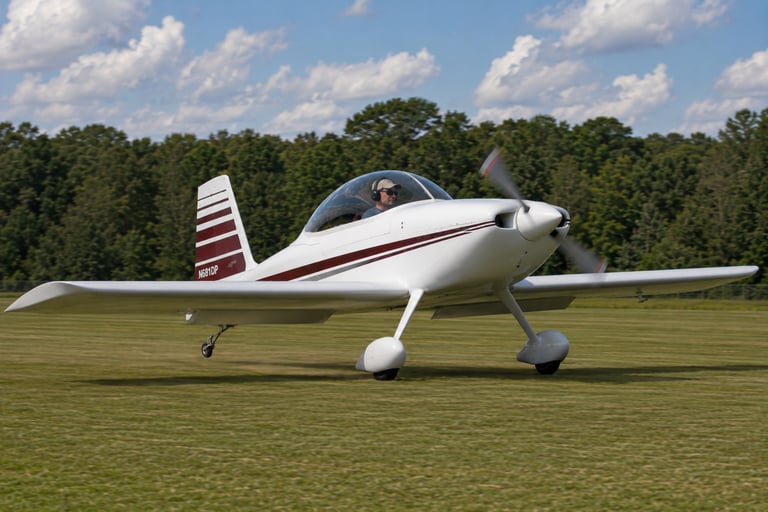
If you spend much time around RV-8 pilots, it won't take long before somebody brings up the old debate about three-point landings versus wheel landings. Before long, everybody has an opinion, and most of them are convinced theirs is the right one. The truth is that both techniques work well in the RV-8 when they're executed properly. However, after years of discussion among experienced RV-8 pilots, a general consensus seems to emerge: while proficiency in both techniques is important, many pilots eventually come to favor a tail-low wheel landing as the airplane's most natural arrival.
The three-point landing is the traditional tailwheel touchdown. You're easing the airplane onto the runway right at the stall, with the mains and tailwheel touching down at about the same time. Pilots who favor the three-point landing appreciate the slower touchdown speed, shorter rollout, and the satisfaction that comes from arriving fully stalled and ready to roll out. When everything comes together just right, it's one of the most rewarding landings a tailwheel pilot can make.
A good three-point landing requires patience. The temptation is often to force the airplane onto the runway, but the RV-8 generally rewards pilots who simply keep flying a few inches above the pavement and allow the airplane to settle when it's ready. Done properly, the touchdown can be nearly imperceptible.
That said, the RV-8 is somewhat unique among tailwheel airplanes. Many pilots find that a full three-point attitude feels slightly awkward. The sight picture can seem unusual, particularly for pilots transitioning from other tailwheel aircraft. It often feels as though the nose is higher than expected, requiring a fair amount of trust because forward visibility becomes limited. If even a little excess speed remains, the airplane may reward the pilot with a skip or bounce before finally settling.
Part of this stems from the RV-8's efficient wing and clean aerodynamics. These airplanes simply do not like to stop flying. Even after initial contact, the wing may still be producing enough lift to keep the airplane light on its wheels if speed has not been completely dissipated. As a result, many pilots find that consistently achieving a true full-stall three-point landing requires more precision than it does in older, draggier tailwheel aircraft.
For that reason, many experienced RV-8 pilots prefer what is often described as a tail-low wheel landing. Rather than arriving in a full three-point attitude, the airplane is flown onto the mains with the tail only slightly elevated. The touchdown occurs under positive control with a small amount of remaining airspeed, and as the aircraft decelerates, the tailwheel settles naturally onto the runway.
This technique seems to fit the RV-8's personality particularly well. Visibility over the nose remains better, directional control is excellent, and the airplane tends to feel more planted during the transition from flight to rollout. Many pilots report that the RV-8 simply behaves better when allowed to touch down this way rather than being coaxed into a perfect full-stall arrival.
The tail-low wheel landing also allows the pilot to remain ahead of the airplane. Instead of waiting for the aircraft to completely quit flying, the pilot maintains positive control all the way through touchdown and rollout. A small amount of forward stick pressure after touchdown helps keep the mains firmly planted until aerodynamic forces naturally diminish and the tail settles.
Crosswinds are where this technique particularly shines. When a gusty Texas afternoon breeze is blowing across the runway, many RV-8 pilots feel they have better authority and greater confidence by touching down on the mains first and keeping the airplane flying under control until it is firmly established on the runway. Rudder effectiveness remains strong, and the airplane generally tracks straighter throughout the landing roll.
Of course, wheel landings are not without their challenges. They require good timing and smooth control inputs. If the airplane is allowed to rebound or if the pilot begins chasing a bounce with aggressive pitch corrections, things can deteriorate quickly. As with most aspects of flying the RV-8, smoothness and patience are usually rewarded.
They also tend to use somewhat more runway than a properly executed three-point landing. On most paved runways frequented by RV pilots this is rarely a concern, but it may become a factor on shorter strips where every foot matters.
Runway condition plays a role as well. On smooth pavement, either technique works exceptionally well. On grass strips or rougher surfaces, some pilots still favor a true three-point landing because the slower touchdown speed reduces loads and minimizes the tendency to skip. Others continue to prefer a tail-low wheel landing because of the excellent directional control it provides. Once again, pilot experience and comfort often drive the decision.
After talking with RV-8 pilots over the years, the consensus seems fairly clear. Most experienced pilots are comfortable performing both techniques and understand when each is appropriate. Yet if forced to choose only one landing style for everyday operations, many would likely select the tail-low wheel landing. It appears to complement the RV-8's aerodynamic characteristics, visibility limitations, and handling qualities particularly well.
Perhaps that's why the debate never really gets settled. Every RV-8 pilot eventually develops a favorite, but most admit there are situations where either technique can be the right answer. The truly proficient pilot does not view three-point and wheel landings as competing philosophies. Instead, they are simply tools available for different conditions.
In the end, the goal is not proving that one method is superior. The goal is being proficient enough to use either one whenever conditions warrant. Around the hangar, you'll hear plenty of opinions, but many experienced RV-8 pilots seem to agree on one thing: the airplane—and its pilots—often appear happiest arriving in a well-executed tail-low wheel landing.
And if that landing is smooth enough that your passenger doesn't realize you've touched down yet, well, that's even better.
The First 10 Hours in an RV -
April 29, 2026
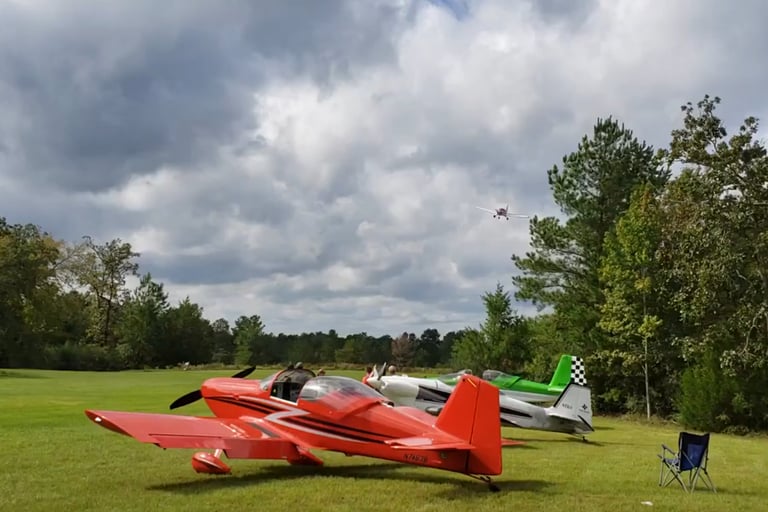
There’s a moment in every pilot’s transition into an RV when the pace picks up and the airplane starts to feel a step ahead. It’s not misbehavior—it’s precision. The airplane is doing exactly what it was designed to do, responding quickly, carrying energy efficiently, and revealing every habit you bring with you. Those first 10 hours matter because they shape how you’ll fly the airplane from that point forward. The most important lesson shows up almost immediately: airspeed discipline is everything. In an RV, a little fast isn’t just a little fast—it’s excess energy that has to go somewhere, usually into float and runway you didn’t plan to use. Flying the correct speeds, every time, is the foundation everything else builds on.
Part of that discipline is understanding that the RV line is not one-size-fits-all when it comes to approach behavior. As a general rule:
“The RV line splits into two personalities—sport airplanes that reward a slightly steeper, disciplined approach, and touring airplanes that are more forgiving but will carry energy longer and tempt pilots into flatter finals.”
The conventional-wing RVs—the -3, -4, -6, -7, and -8—tend to feel more stable and predictable when flown on a slightly steeper approach. The -9, -14, and -10 lean more toward a forgiving, stable profile, but even those benefit from a modestly steeper descent than many pilots initially fly. Propeller type plays into it as well, but regardless of configuration, the airplane rewards a profile that keeps you ahead of it rather than trying to fix energy late.
That’s where a common habit shows up - especially with newer RV pilots. On final, the speed starts to creep up. It’s subtle at first. Whether it’s comfort with control feel or just a natural tendency to avoid getting slow, many pilots let the airplane accelerate in the last portion of the approach. In an RV, that’s not a harmless habit. It directly leads to long landings, inconsistent touchdowns, and problems on shorter runways. More importantly, it breaks the rhythm of a stable approach. Discipline matters here. The goal isn’t just to get on the runway, it’s to arrive there the same way every time, at the correct speed, on the correct glide path.
The sight picture reinforces all of this. If you’re coming out of a Cessna or Piper, what you see over the nose will not match what you’re used to. Many pilots initially fly the RV too flat, which feeds directly into that tendency to carry extra speed. Learning the proper visual reference - and trusting it - is a turning point. Once that clicks, the airplane starts to settle into place. The controls demand the same kind of restraint. RVs are light and responsive, and they don’t require large inputs. If you find yourself making big corrections, you’re likely over-controlling. The airplane responds best to small, deliberate pressures that let it stabilize rather than chasing it.
Energy management ties it all together. The RV will hold speed longer than you expect, so slowing down isn’t something you fix on short final—it’s something you plan for early, starting on downwind and base. By the time you’re established on final, the work should generally be done. That also helps manage the feeling that the pattern is compressed. Everything happens quicker, and new RV pilots often feel rushed. The answer isn’t to speed up, it’s to think ahead, and to stay in front of the airplane instead of reacting to it.
Perfection isn’t the goal in those first 10 hours, consistency is. The same speeds, the same glide path, the same sight picture, repeated until they become natural. Confidence grows out of that repetition, and precision follows. The RV isn’t a difficult airplane; it’s an honest one. It gives you exactly what you ask for, no more and no less. If you respect that, stay disciplined, and commit to consistent approach performance, those first 10 hours won’t just be a transition, they’ll be the foundation for everything that comes after.
Aircraft Flying Tool Kits -
April 6, 2026
To those who know me, this will come as no surprise: I suffer from a few anxieties. Not the dramatic kind, but the quiet, persistent sort that show up at inconvenient times. A slice of cake flipping upside down onto its icing while being served. Running late to church. Tools not being placed back into their proper locations in the tool chest. And of course, the modern fear of leaving your cell phone at home. I’m not sure how I managed before the late ’90s, but today the idea of heading anywhere without a charged phone feels like a poor life decision.
Now that we’ve set the stage, let’s talk about one of my flying concerns. That would be not having a proper emergency tool kit onboard—especially when venturing any real distance from the home airfield. A quick local flight doesn’t bother me much. But stretch the radius a bit, and I want that kit within reach.
That mindset wasn’t born out of theory. It came from experience.
Once, on a flying vacation some eight hundred miles from home, I had a flat tire. There I was, far from anything familiar, reminded that mechanical problems don’t care where you are or what you had planned. They just show up. Since then, I’ve had a hard time enjoying any trip—by air or by road—without the means to deal with a reasonable amount of trouble myself.
Airplanes reinforce that lesson. On one trip, I had to change out a switch away from home. Nothing glamorous, but when a small electrical component quits a hundred miles from your hangar, it suddenly becomes the most important part on the airplane. Having the tools and a few spare parts turned what could have been a grounded trip into a short delay.
I’ve seen it play out with others, too. One friend had a broken exhaust while away from home. With a little creativity and just enough confidence to proceed, we wrapped the break with metal cut from a can and secured it well enough for him to fly about thirty miles home. Not pretty, but effective.
Another friend had a similar failure. This time, we used the tool kit to disassemble the broken exhaust, flew the pieces home for repair, then returned and reassembled everything where the airplane sat. It wasn’t quick, but it worked. And that’s the point—when you have tools, you have options. Without them, you’re just standing there hoping the problem fixes itself.
That philosophy doesn’t stop at the airport. I often take the tool kit with me in the rental car at the destination. Over time, I’ve used it to fix all kinds of small issues away from the airplane—things that would otherwise turn into inconveniences or delays. A few tools can turn a problem into nothing more than a short pause.
Because of that, I’ve become intentional about what I carry. The goal is simple: combine functions and minimize weight.
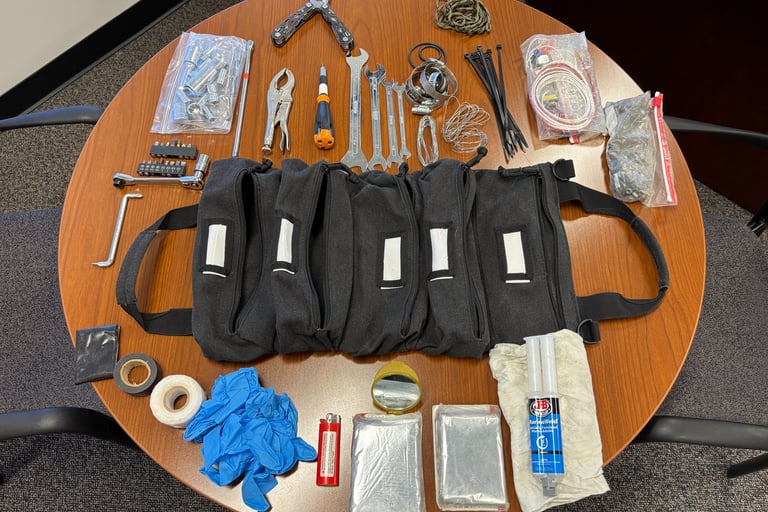
At the heart of the kit is a good knife or multi-tool—the kind that can do a little bit of everything. I carry a compact bit driver with Torx and various screwdriver tips, covering most of what I’m likely to encounter. A set of locking pliers serves double duty, functioning both as a clamp and as a standard pair of pliers. I keep a small set of flat open-end wrenches—nothing excessive, just the sizes that matter on the airplane.
Beyond tools, I carry materials. Sections of stranded wire, a handful of common fasteners, washers, and nuts that match what’s typically used on the airplane. A couple of general-duty switches, connectors, and crimp fittings—small items, but often the difference between being stuck and being mobile.
There’s a section of heavy-duty duct tape, because experience has proven that duct tape earns its place in any kit. A tube of epoxy repair putty for those situations where something needs to be held together just long enough to get home. Cable ties—more useful than they have any right to be. A pair of nitrile gloves, because sometimes the job gets messy.
And in writing all this out, I realized I had overlooked two items that absolutely belong in the kit: an old pair of reading glasses—for those of us who need them—and a surplus sick sack. One helps you see what you’re fixing. The other…well, it helps you deal with everything else.
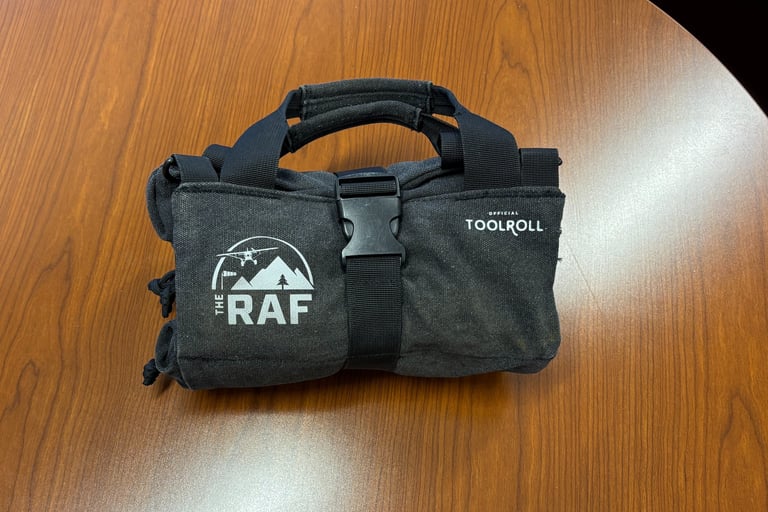
All of this, surprisingly, comes in at about six to seven pounds total. Not insignificant, but not excessive either—especially when you consider what it can save you. The entire kit packs neatly into a roll-style tool bag, compact and organized (courtesy of the RAF!) One photo shows everything laid out—the full inventory in plain view. The other shows it packed, rolled up, and ready to go. It’s a small footprint for a lot of capability.
I don’t stop at tools. The kit also includes a few basic survival items: a rescue mirror, two thermal blankets, and a way to make fire - a flint and steel or at least a lighter. None of it weighs much, and I hope none of it is ever needed. But airplanes have a way of taking you over places where self-reliance matters.
Some might call this overthinking. They may not be wrong. But I’ve found that a little anxiety, properly channeled, turns into preparation. It turns into options. It turns into the quiet confidence that when something goes wrong far from home, you’re not entirely at the mercy of it.
So yes, I like my tools put back where they belong. I don’t like leaving home without a phone. And I don’t like traveling far without a proper kit. Because somewhere between experience and a little bit of worry, I’ve learned this: you may not be able to prevent things from breaking—but you can be ready when they do.